We read 210,759 design prompts sent to Superdesign between January and June 2026 (194,271 of them unique) and the picture is clear: AI design in 2026 is overwhelmingly product UI, not art. Dashboards lead by a mile, about 1 in every 7 distinct projects, followed by landing pages, pricing pages, and login screens. Dark mode is rising (from 27% of prompts to 38%), gradients dominate every other visual device, and people now ask to design "like Linear" more often than "like Apple."
This is not a survey or an analyst opinion. It is the actual corpus of what people typed into an AI design agent for six months. The glamorous demos you see online are 3D hero scenes and brand art. The real work is the boring, load-bearing 80% of product UI: the admin panel, the settings page, the screen nobody screenshots. That gap, between what AI design looks like in demos and what it actually is in practice, is the whole story. (Just here for a number to cite? The quotable reference version is AI UI design statistics 2026.)

What is everyone actually building with AI in 2026?
Product UI, not art. When we counted distinct projects by what they ask for, dashboards win by a wide margin, and the rest of the leaderboard is just as unglamorous: landing pages, pricing tables, login screens, SaaS apps, portfolios. Crypto, the category that dominates AI hype, comes dead last.
distinct projects
Distinct project_id counts (one project iterating 50 times counts once), matched with PostgreSQL word-boundary regex. E-commerce counts both 'ecommerce' and 'e-commerce'.
Dashboards show up in 13,151 distinct projects, more than any other single category, ahead of landing pages (8,433), pricing (5,751), and login (3,755) individually. The long tail tells the same story: SaaS apps (4,646), portfolios (3,630), booking flows (1,978), fintech (1,268), and crypto dead last at 531. To put the hype-to-reality gap in one number: crypto is roughly 1/25th the size of dashboards.
Here is the line a developer would screenshot: nobody is using AI to make art. They are using it to ship the admin panel. The most common thing a person asks an AI design agent to do in 2026 is to draw the screen they least want to draw by hand.
If dashboards and landing pages are what you build most, the best AI UI generator guide covers which tool actually ships them as code, and the AI wireframe generator breakdown covers getting from blank canvas to first draft fast.
Is dark mode really winning in 2026? (and the ai design trends 2026 that hold up)
Yes, and we can show the slope. The share of prompts that explicitly ask for a dark theme climbed from 26.8% in January to 38.1% by May 2026, peaking at 38.3% in April. That is roughly 2 in every 5 designs now requested dark by default. If you want one defensible line for the ai design trends 2026 conversation, this is it: dark mode went from a minority preference to the near-default in a single year.
% of prompts
Monthly share of prompts matching the word 'dark' or 'glassmorphism'. Partial June is excluded so the last month is not understated.
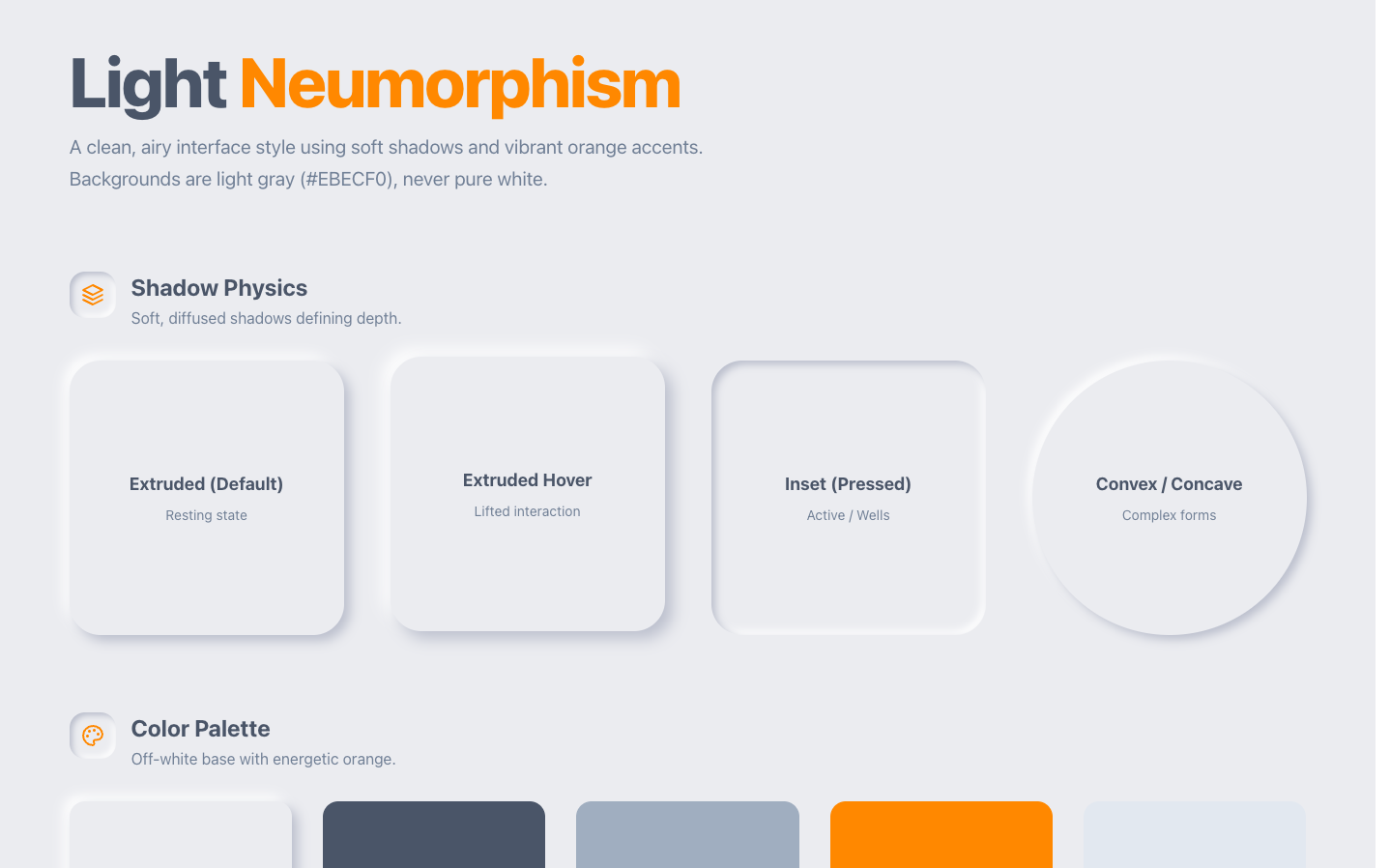
The style-effect data pairs with it. Glassmorphism is quietly climbing, from 5.6% of prompts in January to 8.2% in May, the frosted-glass look is back. Neumorphism, the soft-shadow trend everyone argued about a few years ago, is effectively extinct: just 522 lifetime mentions against glassmorphism's 11,949.
One honest caveat, included on purpose: we deliberately do not publish a brutalism trend line. Our word-boundary count for "brutalism" stays well under 1% of prompts every month, which is too small to claim a real trend. We would rather leave it out than dress up noise as a movement. If a number is too thin to defend, it does not belong on a chart.
What is the most-requested design device, and what colors do people pick?
Gradients win, and it is not close. "Gradient" shows up in 61,193 prompts across 21,505 distinct projects, making it the single most-requested visual device in the entire corpus. After a decade of flat design, the gradient is back as the default way people reach for depth.
The color palette is just as predictable. People overwhelmingly pick cool, safe colors.
prompts
Word-boundary counts: we matched whole words, so 'red' does not catch 'required' or 'centered', and 'blue' does not catch 'bluetooth'.
Blue is the runaway number one (50,165 prompts), then black (42,554), green (41,870), orange (33,797), red (30,862), and purple (20,758). Put the gradient finding and the color finding together and you get the default AI aesthetic of 2026 in one sentence: a blue gradient on a dark background. If your design feels generic, that is probably why.
Does anyone still copy Apple?
Barely. When people say "design it like X" and name a brand, the most-named brand is Linear, not Apple. A developer-tools company outranks the most valuable design brand on earth.
prompts
Counts of prompts matching 'like <brand>'. These are hundreds, not thousands: a niche but directionally striking signal, so read the ranking, not the absolute size.
Linear (229) edges out Apple (173), then Stripe (141), Notion (67), Vercel (35), and Airbnb (24). The honest framing: these are hundreds of prompts, not thousands, so do not over-read the exact gap. But the order is the point. Taste in 2026 is set by the tools developers live in all day, not by the consumer giants design schools still teach. Nobody copies Apple anymore. They copy Linear.
How do people actually work with an AI design agent?
They iterate. They do not one-shot. 40% of all generations are refinements of an earlier one, not fresh first drafts (83,349 of 210,777), which means people branch and refine rather than expecting a perfect answer in one go. The deepest single refinement chain in the dataset ran 396 generations deep: one designer who simply would not stop.
The prompts themselves are real paragraphs. The median prompt is 806 characters, roughly 130 words. We report the median on purpose, because the average (5,949 characters) is badly skewed by users pasting whole product requirement docs into the box. People who use AI design well write a brief, not a one-liner.
And it is a weekday job. Work clusters Tuesday through Thursday and craters on the weekend.
drafts
Sunday (21,970 drafts) runs about 35% below the Thursday peak (33,721). AI design is, mostly, an on-the-clock weekday activity.
Sunday bottoms out at 21,970 drafts, about 35% below Thursday's peak of 33,721. For all the talk of AI unleashing nights-and-weekends creativity, the data says AI design is work people do at work. The garnish worth keeping: these prompts came from 160 countries, led by India and the United States, with Brazil, China, and Japan close behind. This is a global habit now, not a Silicon Valley one.
The way these prompts get written, iterate cheap, refine the winner, mirrors how the canvas is meant to work: explore directions in parallel instead of re-prompting one linear thread. That is the heart of what vibe design means, and why a coding agent like Cursor still needs a design surface.
How we counted (methodology)
This box is a credibility feature, not boilerplate. Here is exactly what we did, so you can trust the numbers or poke holes in them.
- Source. Every figure comes from
design_drafts.prompt, one real user prompt per generation. We did not use chat logs, which re-inject prior context and inflate counts. - Word-boundary matching. For category, color, and style counts we used PostgreSQL word-boundary regex, so "red" means the word red, not "required" or "centered", and "dark" does not catch "darken" inside another word.
- Distinct projects for categories. Headline category numbers are distinct project counts, not raw prompt counts, so one person iterating 50 times on a dashboard counts once. That makes them conservative.
- Median, never mean. We report the median prompt length (806 chars) because pasted requirement docs make the average (5,949) meaningless.
- Window. 2026-01-08 to 2026-06-14, 210,759 drafts, 194,271 unique. Country data comes from product analytics over the same window (160 countries across 110,170 generation events).
- Privacy. We publish only aggregates. No raw user prompts appear anywhere in this post, because people paste real company names and roadmaps, and no revenue or account data is involved.
Two honest corrections we made along the way. We dropped a brutalism trend line because our strict word-boundary count is under 1% of prompts (too thin to call a trend). And we count "e-commerce" and "ecommerce" together, because splitting them on the hyphen understated the real total.
Try it on your own screen
Most of these 210,000 prompts were the same quiet thing: someone trying to get an unglamorous screen out the door a little faster. The dashboard, the pricing page, the login they kept putting off. You can do the same in a couple of minutes.
Want prompts you can copy right now instead of writing your own? We collected the constraint-rich ones that actually beat the generic look, organized by screen: the best UI design prompts for any model, and a set tuned to one agent's weaknesses in Claude Code design prompts.
There are two ways in. Prompt it on the web app and watch the canvas draw, or drive that same canvas from Claude Code or Cursor with the one-line Superdesign skill, so the design step lives where you already work. Open the canvas, describe the screen you keep putting off, and watch it draw. Stuck? Ping us and we will dial it in together.
If you want the wider picture, the AI design stack for 2026 maps which tool wins at each stage of a real workflow, with this dataset as the backdrop for what people are building in the first place.