Search "best AI UI generator" and you'll get a dozen lists of tools aimed squarely at designers: Figma plugins, web-based mockup tools, drag-and-drop canvas builders. Great if you're a designer. Not what you need if you're a developer who just wants to ship a UI that looks good without opening Figma.
This guide is different. It covers the best AI UI generators specifically for developers, tools that output code you can actually use, work inside your IDE, and don't require you to learn a visual design workflow to get results.

What makes an AI UI generator useful for developers?
Before getting into the list, it's worth being clear about what "useful for developers" actually means. The criteria are different from what designers care about.
A developer evaluating an AI UI generator needs:
- Production code output, React, HTML, Tailwind, or framework-specific components that drop into a real codebase. Not mockup images. Not Figma exports. Actual code.
- IDE integration, The tool should live where developers already work: VS Code, Cursor, Claude Code, Windsurf. Switching to a separate browser tab to generate UI and then copy-pasting it back into your editor is friction that compounds over time.
- Codebase awareness, The best tools know what you've already built. They generate components that match your existing style system, use your design tokens, and don't introduce new patterns that conflict with your current codebase.
- Natural language interface, Describe what you want in plain English. No canvas manipulation, no layer naming, no component library navigation.
- Speed, Developers ship constantly. The UI generator needs to keep up. Generate, iterate, ship, in minutes, not hours.
With those criteria in mind, here are the best AI UI generators for developers in 2026.
1. Superdesign: Best AI UI generator for developers
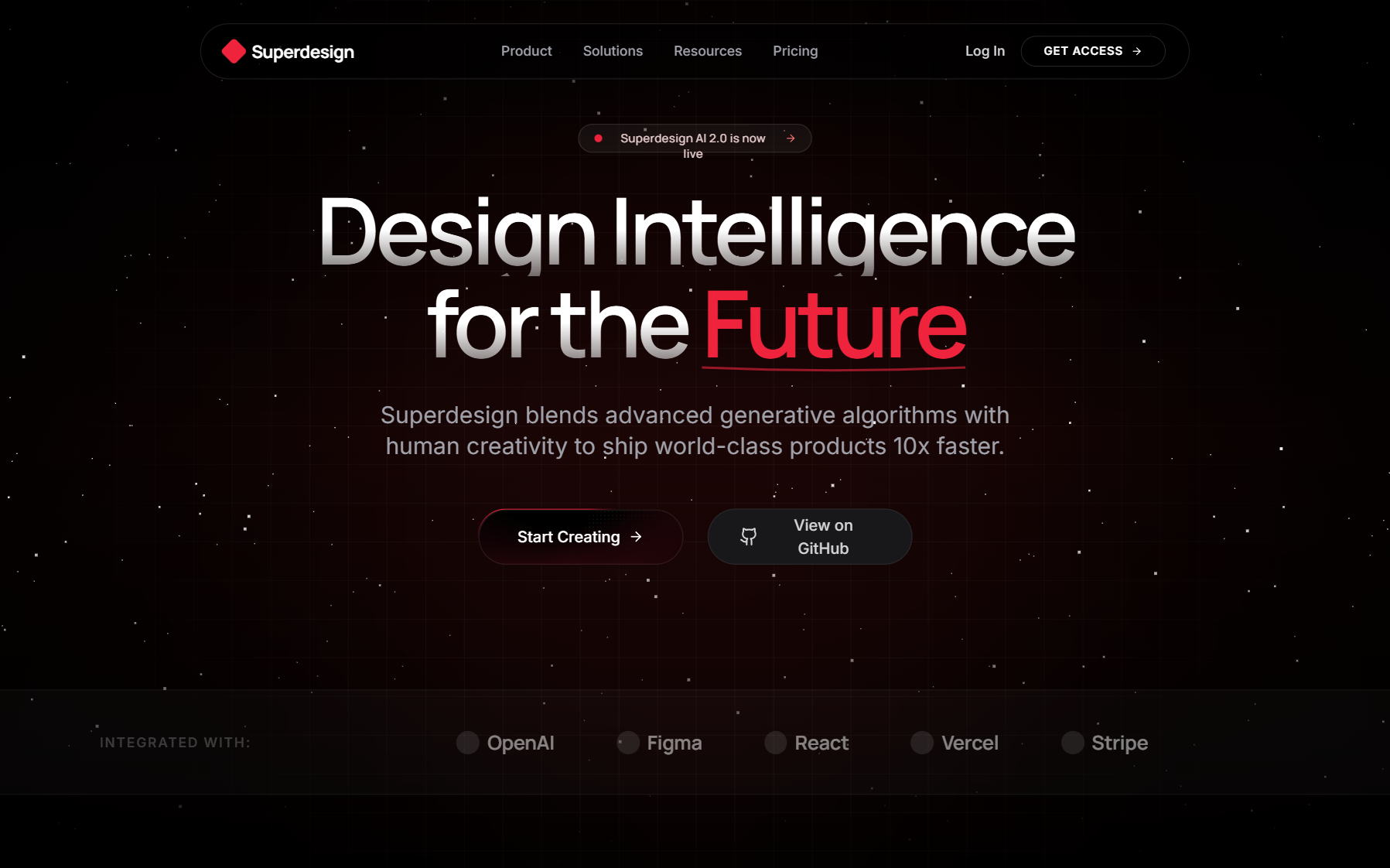
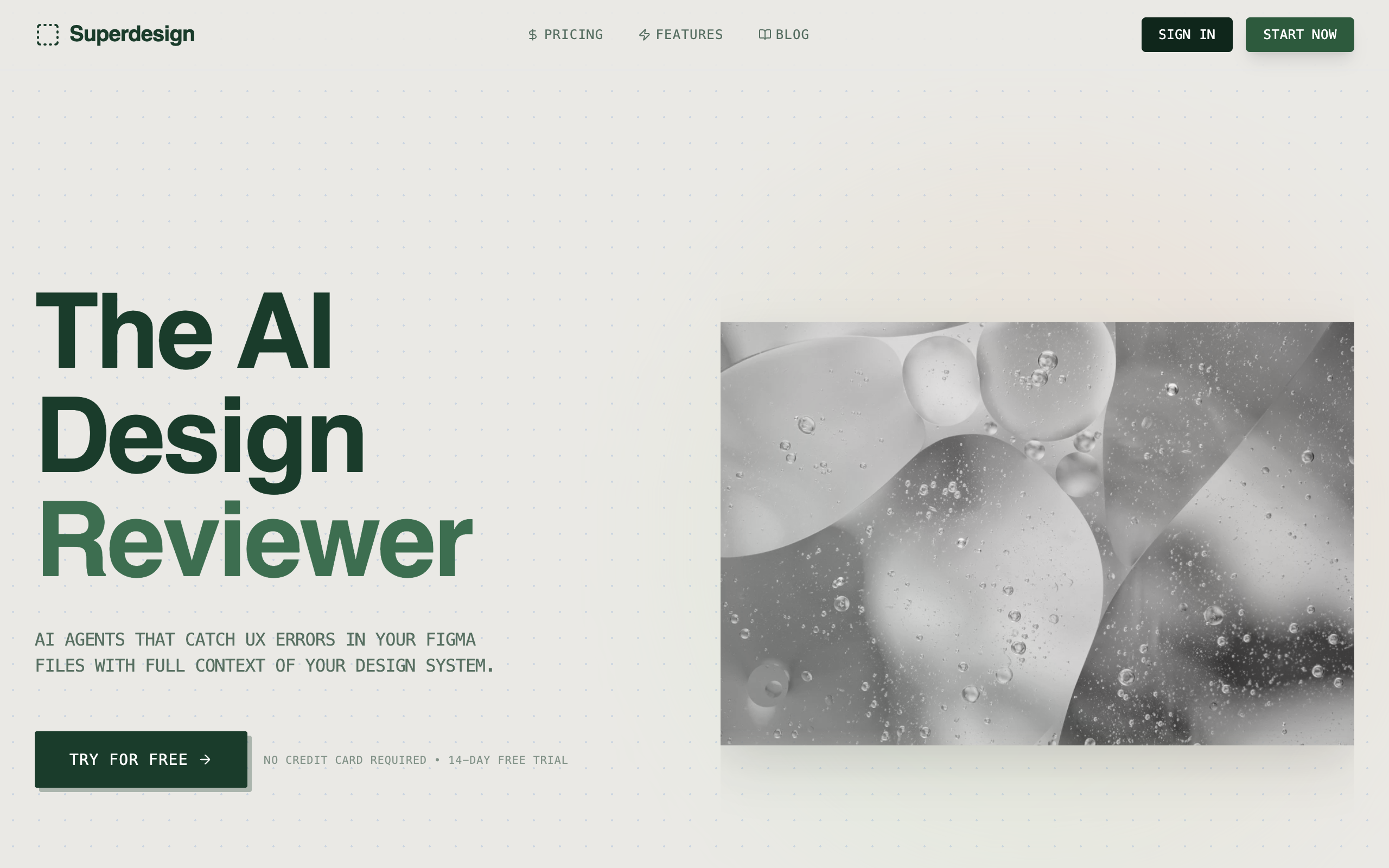
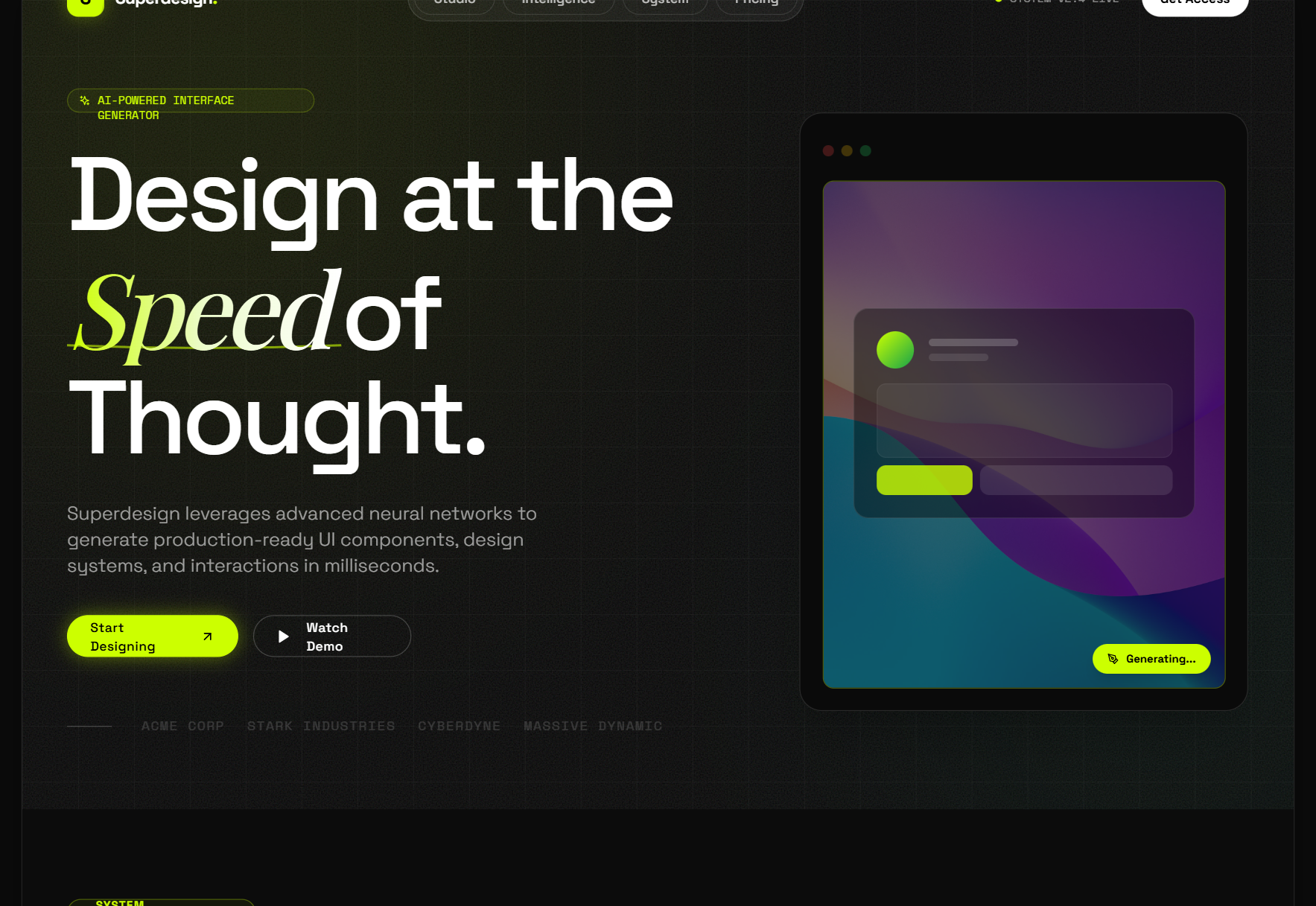
Superdesign is built specifically for the developer-as-designer workflow. It's an AI design agent that lives inside your IDE, VS Code, Cursor, Claude Code, and Windsurf are all supported natively, and generates production-ready UI from natural language prompts.
The key thing that separates Superdesign from every other AI UI generator on this list: it produces code, not mockups. When you describe a UI in Superdesign, you get React components and Tailwind classes that go directly into your project. There's no intermediate design step, no Figma export, no manual re-implementation. You describe it, you get the code, you ship it.
What makes Superdesign different for developers
- IDE-native workflow. Install the extension from the VS Code Marketplace or Cursor store and you're generating UI inside the same environment where you write code. The output lands directly in your project, no copy-paste from a browser window.
- DESIGN.md configuration. Define your visual language once in a DESIGN.md file, typography scale, color palette, spacing system, component patterns, and every generation follows those rules automatically. Your UI stays consistent across the entire codebase without manually enforcing standards.
- Codebase-aware generation. Superdesign reads your existing components and style configuration. New components match your current design system rather than introducing generic defaults that clash with your existing UI.
- Side-by-side variant comparison. Generate multiple layout approaches simultaneously, compare them visually, pick the best one, and iterate, all without leaving your editor.
- No waitlist. Available now. Install and start generating UI in under 5 minutes.
Superdesign Pro is $20/month. For solo developers or small teams who were previously spending hours implementing mockup specs or paying for contractor design work, the ROI is immediate. To get a feel for the output before installing anything, browse the design prompt library, a free collection of UI design prompts you can copy and run.
2. V0 by Vercel: Best for React component scaffolding
V0 is Vercel's prompt-to-UI tool. You describe a component or page in natural language, and V0 generates React code built on shadcn/ui and Tailwind CSS. The output is clean, modular, and immediately usable in any React project.
V0 is the closest thing to a pure "describe a component, get the code" workflow. Its strengths for developers:
- Real React and TypeScript output, not pseudocode, not mockups
- Solid coverage of common UI patterns: data tables, forms, dashboards, navigation, cards
- Free tier is genuinely useful for low-volume generation
- Agentic capabilities: V0 can search the web, inspect live sites, and fix errors automatically
- One-click Vercel deployment for prototypes
The limitations worth knowing:
- No IDE integration, you work in V0's browser interface, then copy the output into your project
- No codebase awareness, every generation starts from scratch, unaware of your existing components or design tokens
- Strongly opinionated toward shadcn/ui and Tailwind, less useful if you're on a different stack
- Better for isolated components than full-page layouts or multi-screen flows
V0 is the right choice when you want a fast, free, code-first component generator and you're comfortable with the browser-to-editor copy-paste workflow. For anything more integrated or codebase-aware, Superdesign is the stronger option.
3. Bolt.new: Best for full-stack scaffolding from scratch
Bolt.new is a full-stack app generator: describe an application and Bolt generates the frontend, backend, database schema, and API routes. It's the right tool when you're starting a new project from zero and want a complete working scaffold in minutes.
As a UI generator specifically, Bolt is strongest at getting you to a working baseline quickly. You can iterate on the UI through follow-up prompts and see changes in Bolt's built-in preview environment.
Where Bolt falls short as a UI generator:
- No IDE integration, it's a standalone browser environment separate from your editor
- Not designed for adding or improving UI in an existing project, it's really for greenfield starts
- Prioritizes "working app" over "polished UI", functional but often visually generic out of the box
- Generated code can be difficult to customize or integrate with an existing codebase
Use Bolt when you're spinning up a new project and want a complete working scaffold. Use Superdesign when you need to add, improve, or iterate on UI inside an existing codebase.
4. Figma Make: Best for designer-developer handoff teams
Figma Make is Figma's prompt-to-prototype feature. You describe a UI, Figma generates an interactive prototype, and your team can inspect, comment, and test it before development begins. It also includes an MCP server that brings Figma design context into agentic coding tools like Cursor and Claude Code.
For developers specifically, Figma Make is most useful when you're on a team that uses Figma as the source of truth. The MCP integration means you can generate UI in Figma and have your AI coding tool reference those designs directly.
The gaps for developer-led workflows:
- Output is prototypes, not production code, you still have to implement the design after generating it
- Requires a Figma subscription ($20/month per editor minimum)
- Generated designs often don't map cleanly to existing design systems
- Primarily useful for teams, not individual developers working solo
Figma Make makes sense if your team already centers around Figma and you need a faster way to generate designs for handoff. For developers who are also the designer, it adds a step instead of removing one.
5. Google Stitch: Best for AI-native mockup generation
Google Stitch (formerly Galileo AI, acquired by Google in 2025) generates UI mockups from natural language prompts or uploaded images. It supports voice input, outputs designs to Figma, and can export basic HTML and CSS. Google coined the phrase "vibe design" in its announcement and positioned Stitch as the reference implementation for prompt-driven design.
For developers evaluating AI UI generators, Stitch has some real gaps:
- No production code output, Stitch generates mockups, not React or framework-specific components
- No IDE integration, web-only tool with no VS Code or Cursor extension
- No codebase awareness, generates from scratch without knowing your existing components or style system
- Still limited access as of mid-2026, many users are still on the waitlist
Stitch is genuinely useful for rapid mockup generation and concept validation, especially for non-developers who need to communicate UI ideas to a team. For developers who need to ship production code, the output gap is significant.
6. UX Pilot: Best for designer-workflow AI UI generation
UX Pilot is an AI UI generator that produces high-fidelity mockups and wireframes from prompts, with a Figma plugin for integration with design workflows. It includes a predictive heatmap feature that shows where users are likely to look, useful for validating layouts before building.
UX Pilot is the right tool if you're a designer who also codes. It produces polished, pixel-accurate mockups and integrates cleanly with Figma. For pure developers who want to skip the mockup step entirely and go straight to code, it's the wrong layer of abstraction.
7. Magic Patterns: Best for design system-aware UI generation
Magic Patterns generates React components that match an existing design system. You upload your design tokens, component library, and styling configuration, and Magic Patterns generates UI that follows those rules. It supports Shadcn, Mantine, Chakra UI, Tailwind, and Radix Themes.
This is the most specialized tool on the list. If you have an established design system and need to generate new screens that match it precisely, Magic Patterns is worth evaluating. For developers without a formal design system (common for solo devs and small teams), the setup overhead is significant and the benefit is lower.
AI UI generator comparison: developer criteria
| Tool | Production code output | IDE integration | Codebase aware | Natural language input | Price |
|---|---|---|---|---|---|
| Superdesign | Yes, React, HTML, Tailwind | Yes, VS Code, Cursor, Claude Code | Yes | Yes | Free + $20/month Pro |
| V0 by Vercel | Yes, React, shadcn/ui | No, browser only | No | Yes | Free + $20/month Pro |
| Bolt.new | Yes, full-stack | No, browser only | No | Yes | Free + paid tiers |
| Figma Make | No, prototypes only | Via MCP only | Partial (design system) | Yes | $20/month (Figma plan) |
| Google Stitch | Partial, basic HTML/CSS | No, web only | No | Yes (+ voice) | Free (limited access) |
| UX Pilot | Partial, HTML/CSS | Via Figma plugin | Partial | Yes | $12/month+ |
| Magic Patterns | Yes, React, Tailwind | Chrome extension | Yes (design system) | Yes | $19/month+ |
Why do most AI UI generators miss developers?
The most popular AI UI generators are built for design teams. That makes sense, designers are the primary buyers of design tools, and the design tool market is large. But it means that the default assumptions baked into most tools don't match how developers work.
Most AI UI generators assume you want a mockup. They output to Figma, to design files, to image exports. The implicit assumption is that someone else (an engineer) will take that output and implement it in code. For solo developers, small teams, and vibe coders building their own products, this assumption is wrong. You're the engineer. You need the code, not a picture of what the code should produce.
This is the core gap that Superdesign was built to close. The design and the implementation are the same artifact. You describe the UI, you get the code, you ship it. No translation step, no context switch, no separate tool for "design" versus "build."
For developers working in Cursor, Claude Code, or VS Code, this difference in workflow is substantial. Every context switch, from editor to browser, from browser back to editor, copy-paste the generated code, fix the import paths, adjust the styling to match your design system, adds friction that compounds across every UI change you make.
How do you choose the right AI UI generator for your workflow?
The right AI UI generator depends on what output you actually need and where you work.
You need production code + IDE integration
Use Superdesign. It's the only tool in this list that combines production code output with native IDE integration and codebase awareness. If you're building inside Cursor, Claude Code, or VS Code and you want to generate UI without leaving your editor, Superdesign is the clear choice.
You need fast React components and don't mind copy-pasting
Use V0. It's free at the basic tier, the output quality is high, and the shadcn/ui-based components work well in most React projects. The browser-based workflow requires copy-pasting, but if that's acceptable for your cadence, V0 is excellent value.
You're starting a new project from scratch
Use Bolt.new. Full-stack scaffolding from a single prompt. Bolt gets you to a working baseline faster than any other tool when you're starting with nothing.
Your team uses Figma as the source of truth
Use Figma Make. If designers and developers are collaborating around Figma files, Figma Make accelerates the design phase without changing the handoff workflow.
You have a design system and need to generate consistent UI at scale
Use Magic Patterns. The design system integration is best-in-class for teams that have invested in establishing a component library and design tokens.
The AI UI generator for vibe coders
Vibe coding changed the default assumption about who builds software. Before, building a product meant hiring an engineering team. Now, a solo founder with Claude Code or Cursor can ship a working application in a weekend.
Vibe design is doing the same thing to UI. The assumption that you need a designer to produce polished UI is becoming less true every month. The right AI UI generator lets you describe what you want, get production-ready code, and ship, without a design handoff step, without Figma, without a dedicated design resource.
For developers who are also building their own products, indie hackers, solo founders, small technical teams, this is the right tool for the job. Superdesign is built for this workflow: AI design agent, IDE integration, production code output, DESIGN.md for consistency. You build the product. The AI handles the design.