Search "AI wireframe generator" and you get the same results: Flowstep, Uizard, Visily, Banani, all excellent tools for designers who want to sketch UI faster. What you don't find is a tool built for the developer who doesn't want a wireframe at all. They want the code.
This is the gap. Every AI wireframe generator in 2026 assumes the same workflow: generate a mockup, hand it to a designer, refine in Figma, hand it to an engineer, implement in code. For solo developers, indie founders, and vibe coders building with Cursor or Claude Code, this workflow adds three unnecessary steps. You're the engineer. You're also the designer. You need to go from idea to production UI, not idea to Figma frame.
This guide covers AI wireframe tools for developers: what they actually output, where they fit in a coding workflow, and which one closes the gap entirely.

What do developers actually need from a wireframe tool?
Wireframing, for developers, isn't really about wireframes. It's about answering the question: "What should this UI look like?" as fast as possible, without context-switching into a visual design tool.
The traditional wireframe workflow, open Figma, create frames, arrange boxes, add typography, share for review, get Figma specs, implement, is designed for teams where design and engineering are separate roles. For a solo developer or small team where one person does both, it's pure overhead.
What developers actually need from a wireframe tool:
- Production code output. Not a picture of a UI. Not a Figma export. React components, HTML, Tailwind classes, code that goes directly into the project.
- IDE integration. The tool should live where developers work: VS Code, Cursor, Claude Code. Not a separate browser tab that requires copy-pasting.
- Natural language input. Describe what you want in plain English. No canvas manipulation, no component library navigation, no layer naming conventions.
- Codebase awareness. Generated UI should match the existing design system, use the established color tokens, and fit the component patterns already in the codebase.
- Fast iteration. Generate, review, adjust with a follow-up prompt, regenerate. The tool needs to keep pace with a developer's coding cadence, not slow it down.
Most AI wireframe generators hit one or two of these criteria. Only one hits all five.
The AI wireframe tool built for developers: Superdesign
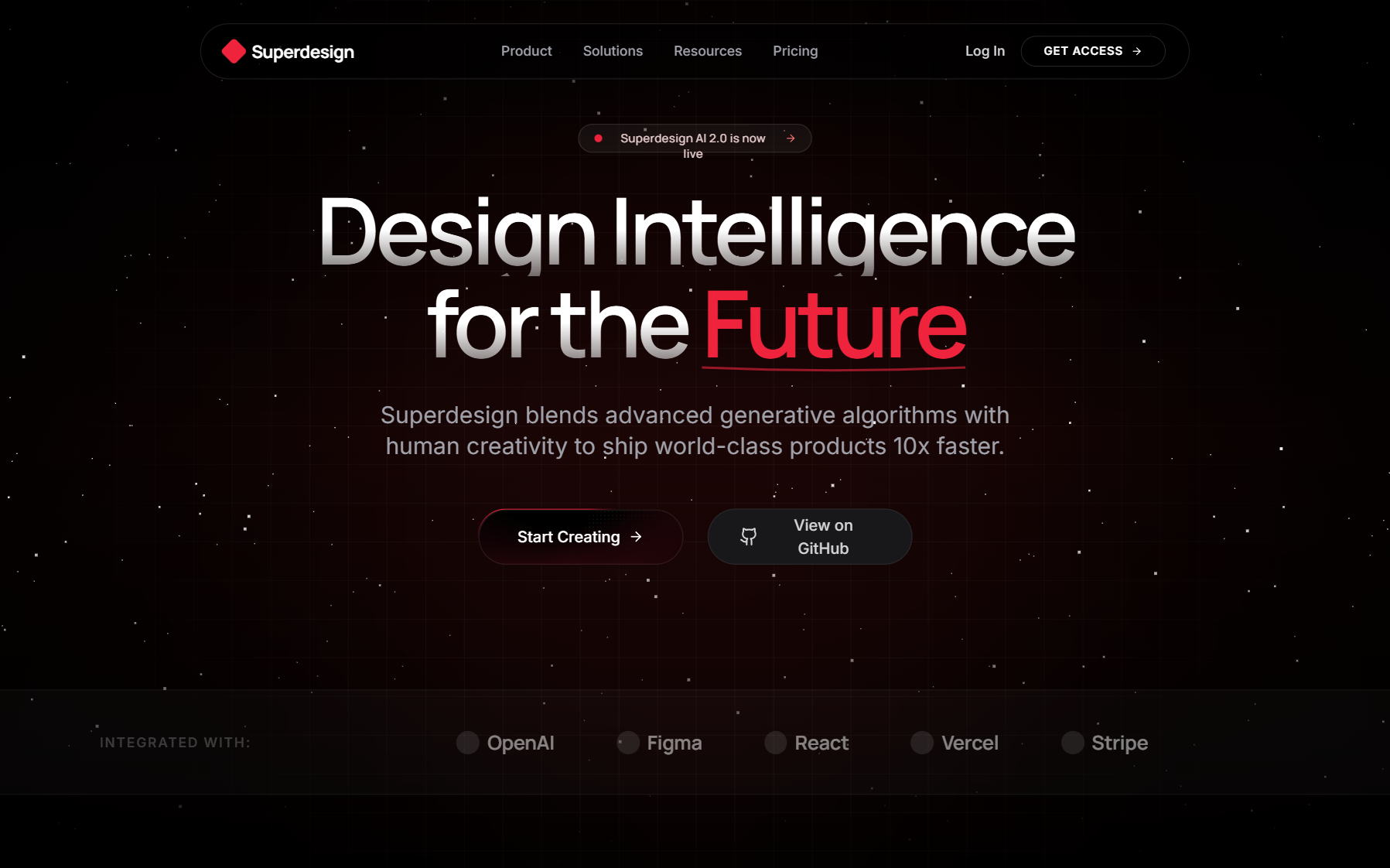
Superdesign is an AI design agent that lives inside your IDE. It's not a wireframe tool in the traditional sense, it skips the wireframe entirely and goes straight to production-ready code. Describe your UI in natural language, and Superdesign generates React components and Tailwind classes that drop into your project. No Figma. No mockup step. No copy-paste from a browser window.
This is what makes Superdesign different from every other AI wireframe generator on this list. The output isn't a prototype you implement later. The output is the implementation.
How Superdesign works in a developer workflow
Install the Superdesign extension from the VS Code Marketplace or Cursor store. From there, the workflow is:
- Open the Superdesign panel in your IDE
- Describe the UI you want: "A settings page with a sidebar, user profile section, and notification preferences"
- Superdesign generates multiple layout variants you can compare side by side
- Pick the best option, iterate with follow-up prompts if needed
- The output lands directly in your project, no copy-paste, no import friction
The DESIGN.md file is a key differentiator. Define your visual language once, typography scale, color palette, spacing system, component patterns, and every generation follows those rules automatically. Your UI stays consistent across the entire codebase without manually enforcing standards on every new component.
What Superdesign generates
- React components (functional, with TypeScript support)
- Tailwind CSS classes, no custom CSS files to maintain
- Responsive layouts that work on mobile and desktop
- Component variants for different states (empty, loading, error, filled)
- Complete pages and multi-section layouts, not just isolated components
Superdesign Pro is $20/month. For developers who were previously spending hours implementing wireframe specs or waiting for design handoff, the time savings alone cover the cost in the first week.
AI wireframe generators: what each one actually outputs
Most AI wireframe generators are built for designer workflows. They produce mockups, Figma exports, and clickable prototypes, visual artifacts that represent what the code should look like, not code itself. Here's an honest breakdown of each major tool and where it fits for developers.
Flowstep
Flowstep is one of the best AI wireframe generators for design teams. It generates high-fidelity wireframes on an infinite canvas from text prompts, supports multi-screen generation, and exports React, TypeScript, and Tailwind CSS. Real-time collaboration with live cursors makes it strong for team-based workflows.
For solo developers or developer-led projects: Flowstep is browser-only, no IDE integration. The workflow is generate-in-browser, copy-paste to project. It's genuinely good at what it does, but it's optimized for design teams, not developer-first workflows. The code export is a bonus feature; the primary use case is visual design.
Uizard
Uizard targets beginners and non-designers. Its Autodesigner 2.0 generates wireframes from text prompts, and a sketch-to-wireframe feature converts hand-drawn sketches into digital layouts. It includes a React code export option.
For developers: Uizard's code output is basic and rarely production-ready. The tool is optimized for fast visual mockups, not code quality. Useful for quickly communicating a layout idea, not for generating code that goes directly into a codebase.
V0 by Vercel
V0 is the developer-adjacent AI UI tool with the best name recognition. It generates React code built on shadcn/ui and Tailwind CSS from text prompts, actual production-quality code, not mockups. The output is consistently clean and modular.
The gap: V0 is browser-only. No IDE integration means your workflow is always prompt in V0, copy output, paste into editor, fix import paths, adjust to match your design system. For low-volume UI work, this is fine. For frequent UI generation across a large project, the context-switching compounds quickly. V0 also has no codebase awareness, every generation starts from scratch without knowledge of your existing components.
Figma Make
Figma Make generates interactive prototypes from text prompts inside the Figma canvas. For teams where a designer reviews and refines before handoff, it accelerates the design phase significantly. The MCP server integration brings Figma design context into Cursor and Claude Code.
For developer-only workflows: Figma Make produces prototypes, not production code. You still implement the design after generating it. The MCP integration is useful, but it's a bridge between Figma and your codebase, not a replacement for the Figma step itself. Requires a Figma plan on top of everything else.
Whimsical AI
Whimsical added AI-powered wireframe and flowchart generation. It's strong for quickly mapping out user flows and application architecture, useful at the planning stage before any UI work begins. Output is low-fidelity wireframes for communication, not implementation. No code export.
Anima Playground
Anima Playground converts Figma designs, prompts, and wireframes into working React apps. It supports MCP handoff to coding agents like Cursor and Claude Code, making it one of the more developer-friendly tools in the traditional design workflow. The limitation: it still assumes Figma is somewhere in your stack. If you're not starting from a Figma design, the workflow is less streamlined.
Wireframe to code: tool comparison for developers
| Tool | Output type | IDE integration | Codebase aware | Skip Figma? | Best for |
|---|---|---|---|---|---|
| Superdesign | Production code (React, Tailwind) | Yes, VS Code, Cursor, Claude Code | Yes (DESIGN.md) | Yes | Developer-first UI generation |
| V0 by Vercel | Production code (React, shadcn/ui) | No, browser only | No | Yes | Component scaffolding (copy-paste) |
| Flowstep | High-fidelity mockup + code export | No, browser only | No | Yes (optional) | Design teams with code export needs |
| Figma Make | Interactive prototype | Via MCP only | Partial | No, requires Figma | Designer-developer teams |
| Uizard | Wireframe + basic code | No, browser only | No | Yes | Non-designers, basic mockups |
| Anima Playground | React app from Figma/prompt | Via MCP only | Partial | Partial | Teams with Figma designs to implement |
| Whimsical AI | Low-fidelity wireframe/flowchart | No | No | Yes | Planning and user flow mapping |
Why do most AI wireframe generators miss the developer use case?
The AI wireframe generator market grew out of the design tool market. The primary buyers were always design teams: product designers, UX researchers, PMs who need to communicate UI ideas visually. The tools were built to fit their workflow, canvas-based editing, Figma integration, design system management, clickable prototypes for stakeholder reviews.
That workflow has one big assumption baked in: there's an engineer downstream who will take the design artifact and implement it in code. The design tool doesn't need to produce code because someone else handles that step.
For solo developers and small teams doing vibe coding in Cursor or Claude Code, this assumption breaks down. There is no downstream engineer. You are the designer and the engineer. The design artifact you need isn't a wireframe or a prototype, it's a component that's already in your codebase.
This is why most AI wireframe generators produce the wrong output for developers. They're solving the right problem (how do I quickly visualize a UI idea?) with the wrong artifact (a mockup instead of code).
The shift happened gradually. V0 by Vercel was the first tool to recognize this gap and build around code output. Superdesign went further by adding IDE integration and codebase awareness, removing the copy-paste step and the design-system drift that comes from generating UI without context.
How does the wireframe-to-code workflow work for vibe coders?
If you're building with an AI coding assistant (Cursor, Claude Code, Windsurf), your UI workflow probably looks like one of two things:
Option A (broken): Ask your coding assistant to generate UI. Get generic, low-quality components that don't match your design language. Spend 30 minutes tweaking colors, spacing, and typography to make it look acceptable. Repeat for every new feature.
Option B (also broken): Open V0, describe the component, copy the output, paste into your editor, fix import paths, adjust colors to match your design tokens, fix the responsive breakpoints. Works for one or two components. Gets painful at scale.
The workflow that actually works at scale uses a dedicated AI design agent inside your IDE:
- Set up DESIGN.md once. Define your color palette, typography, spacing scale, and component patterns in a DESIGN.md file. Superdesign reads this on every generation, your design language is consistently applied without manual enforcement.
- Describe the UI, get the code. In the Superdesign panel: "A product card with image, title, price, and an Add to Cart button. Hover state should lift the card with a shadow." The agent generates React components and Tailwind that follow your DESIGN.md configuration.
- Compare variants. Superdesign generates multiple layout options side by side. Pick the one that fits best, or combine elements from different variants with a follow-up prompt.
- Iterate in context. Every subsequent generation knows what you've already built. If your codebase uses a Card component with specific props, Superdesign references that instead of generating a new one from scratch.
- Ship. The output is already in your project. No import step, no copy-paste. Resume writing your feature logic.
This is the wireframe-to-code pipeline for vibe coders, except there's no wireframe. You skip straight from intent to implementation. Want a head start? The design prompt library has hundreds of free UI design prompts you can copy straight into Superdesign and adapt.
When do you actually need a traditional wireframe tool?
To be clear: traditional AI wireframe generators are excellent tools for the use cases they're built for. A few scenarios where they're the right choice:
- Stakeholder communication. If you need to show a non-technical stakeholder what an interface will look like, and they're not going to review code, a visual wireframe is faster to produce and easier to discuss than running the application.
- Early planning with a design team. If your team has a dedicated designer who needs to own the design decisions before engineering begins, Flowstep, Figma Make, or Uizard are reasonable tools for that discovery phase.
- User flow mapping. Tools like Whimsical AI are excellent for mapping multi-screen flows, user journeys, and application architecture before any visual design work begins. This is genuinely useful planning work that's different from UI generation.
- Design system governance. Large teams with mature design systems may need tools like Magic Patterns or Figma-native generation that operates within established component libraries. The constraint of matching an existing system precisely is a valid reason to use a design-first tool.
The key question is: what's your output format? If your team needs visual artifacts for review, collaboration, and handoff, use a design-first wireframe tool. If your output is production code that goes directly into a codebase, use Superdesign.
How do you get started with AI wireframe-to-code generation?
If you're already using Cursor, Claude Code, VS Code, or Windsurf, adding Superdesign to your workflow takes about five minutes:
- Install the Superdesign extension from the VS Code Marketplace (search "Superdesign")
- Open your project and launch the Superdesign panel
- Create a DESIGN.md file in your project root, describe your color palette, typography, and component patterns in natural language. Even a basic description ("primary color is #3B82F6 blue, use Tailwind, Inter font, 8px base spacing") significantly improves output quality
- Describe your first UI component. Start with something concrete: a navigation bar, a data table, a form with validation states
- Compare the generated variants and pick the best one
The first few generations will already feel different from asking your AI coding assistant to write UI. The output is design-quality, consistent with your configuration, and ready to use, not a starting point that requires extensive cleanup.
What's the future of wireframing for developers?
The traditional wireframe → design → code pipeline made sense when design and engineering were separate disciplines. A designer would own the wireframe, refine it to high fidelity, and hand it off to an engineer who would implement it. The wireframe was the communication artifact between two roles.
In 2026, that pipeline is collapsing for a growing category of builders. Solo developers, indie founders, and vibe coders doing both jobs don't need an artifact that bridges two roles, they need a tool that goes straight from intent to implementation.
AI wireframe generators evolved from design tools. The best ones added code export as a feature. Superdesign started from the opposite end: an AI agent built for developers who need production UI without the design tooling overhead. The wireframe is an intermediate artifact, code is the goal.
As vibe coding matures, this distinction will become clearer. The tools that win developer workflows won't be design tools with code export, they'll be developer tools with design intelligence built in.