Lovable is the fastest way for a non-technical founder to go from a plain-English prompt to a live full-stack app, and users confirm that magic. The recurring pain is just as documented: credits that drain in debugging loops where you pay to fix the AI's own mistakes, a hard wall once apps get complex, and a 2025 security pattern (CVE-2025-48757) that exposed data in 170+ Lovable apps. Great for greenfield MVPs and demos. Risky as production you do not fully control. Below: every claim backed by a named source and a link.

What is Lovable, and what do users actually say about it?
Lovable (lovable.dev) is an AI full-stack app builder. You describe what you want in plain English, and it generates a React frontend, a Supabase backend, auth, a database, one-click deploy, and a live URL. It grew out of the open-source GPT Engineer project and, in December 2025, raised $330 million in a Series B led by CapitalG and Menlo Ventures at a $6.6 billion valuation (Lovable on Wikipedia). So this is a real, well-funded product, not a flash in the pan.
The honest split users draw, in their own words: they love the speed and the magic-for-non-coders feeling, and they hit credit-loops, a complexity wall, and security gaps. Here is the review.
| Review facts | |
|---|---|
| Product | Lovable, grown out of the open-source GPT Engineer project |
| Maker | Lovable (Series B at a $6.6B valuation, December 2025) |
| Output stack | React frontend plus Supabase backend, auth, database, one-click deploy |
| Pricing model | Subscription plus metered credits (monthly allowance, daily cap, rollover) |
| Sources reviewed | Hacker News, the official pricing page, the public CVE record |
| Facts as of | June 14, 2026 |
One honest disclosure about our sources: Trustpilot and G2 were bot-walled from where we checked, and Reddit was not server-fetchable, so this review compiles Hacker News (verbatim, named, linked), the official pricing page, and the public CVE record. We did not invent sentiment from platforms we could not load.
What do real users love about Lovable?
The consensus strength is speed from prompt to a working full-stack app, especially for non-technical people. The praise is loudest from founders who are not engineers and from technical users who used it for scoped, greenfield prototypes and then took the code further themselves.
The magic-for-non-coders take, from a developer watching a family member use it: "A non-technical family member is working on a tech project, and giving them Lovable.dev with Supabase as a backend was like complete magic. No amount of fiddling with terminals or propping up postgres is too little." (sebastiennight, Hacker News)
The speed, quantified, from a builder who shipped a real product: "It succeeded wildly. I was able to build the whole thing in 3 days. I'm not capable of that on my own, it would have taken me 3 weeks." (windowshopping, Hacker News)
For prototyping an idea, even a non-designer gets something usable: "He created an interactive prototype with lovable.dev and while it fleshes out his idea to me, he clearly isn't strong in UX-design either. Nor does he need to be." (mettamage, Hacker News)
And on code quality as a platform to build on, from a technical user comparing tools: "looking at the code produced, lovable seems to be more precise about the code itself: just cleaner even over several iterations. Which is nice because it gives you a decent platform to continue on with your own code." (albertsikkema, Hacker News)
How much does Lovable cost in 2026, and how do credits really work?
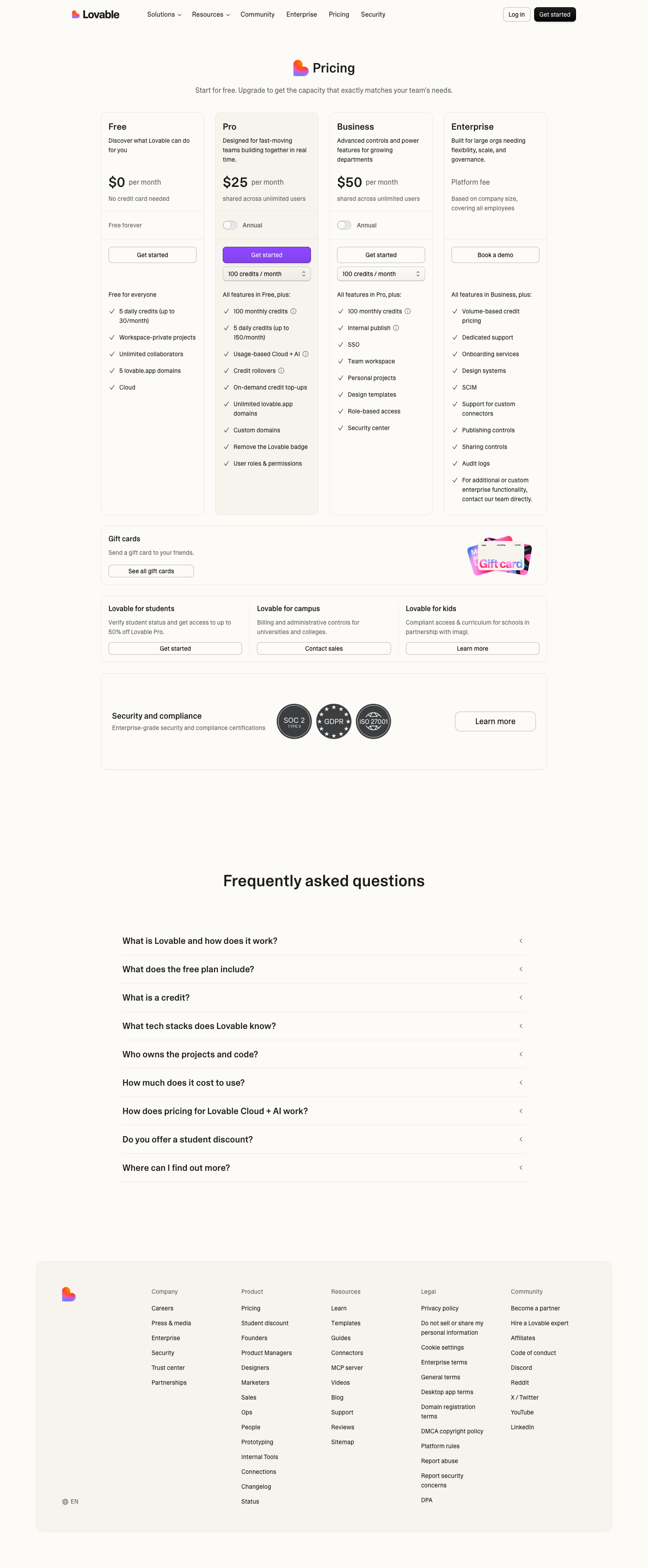
As of June 14, 2026, Lovable is Free, $25/mo Pro, $50/mo Business, and custom Enterprise, and every paid tier runs on metered credits: a monthly allowance plus a daily cap, with rollover.
The exact structure from the live pricing page: Pro is $25/month with 100 credits per month plus 5 daily credits (up to 150 a month), credit rollovers, usage-based Cloud and AI, on-demand credit top-ups, and the option to remove the Lovable badge. Business is $50/month with 100 monthly credits plus team, SSO, and a security center. Enterprise is a platform fee plus volume-based credit pricing. The free tier hands you a few daily credits to try, which is exactly enough to feel the magic before the meter starts.
The structural critique users make is that credits are an abstraction over tokens. As one HN commenter put it: "they abstract away tokens as "credits" and most likely sell the tokens at a ~10x markup. The idea of running a company that sells tokens is like starting a company that sells MySQL calls." (dworks, Hacker News). That ~10x figure is dworks's own estimate, not a verified number, but the pattern of obfuscated credits is real and he names it again elsewhere: "Look at the payment plans for Lovable, Figma Make, Claude Code. None of them charge by token. They charge by obfuscated 'credits'." (dworks, Hacker News)
The failure mode that hurts most is paying to fix the tool's own mistakes, to the point that the company sometimes refunds: "relevant enough to some make companies like Lovable refund credits to customers when errors and token/credit mishandlings are too serious to ignore. That seems unsustainable in the long run though." (mrbungie, Hacker News). And the on-ramp itself is short, by design: "Take the example of Lovable, they offer 5 credits to send few prompts and if you want to continue, you need to pay." (boburumurzokov, Hacker News)
Where does Lovable fall short?
The recurring ceilings are the debugging-loop credit drain, the complexity wall past prototypes, and the security defaults. The first two come up again and again.
On the debug loop, the same builder who shipped in 3 days was honest about the cost: "It took over 100 steps to complete the product, and probably around 10-20 times I had to revert its changes and give it more specific instructions. I had to check its work at every iteration, just like with a junior developer." (windowshopping, Hacker News). Every one of those reverts is a paid loop.
On the complexity wall, the sharpest version: "It's why these no-code/vibe-code solutions like bolt, lovable, and replit are great at hackathons, demos, or basic front-ends but there's a giant cliff past there." (kristopolous, Hacker News). And the abandonment rate among non-technical users: "Everyone non-technical I know who vibe coded either ran into a bug they couldn't fix or abandoned their project." (asdev, Hacker News).
There is a publication's framing worth naming here, but as framing, not a user quote: Superblocks' Lovable review describes the credit experience as feeling "like a slot machine" with "endless debugging cycles" and "cascading modifications in unexpected files" (Superblocks, Lovable.dev review). That is a publication characterizing the pattern, not a verbatim user, and we keep it labeled that way.
Is Lovable safe? The CVE-2025-48757 RLS exposure explained
Lovable's speed comes with a documented security footgun. In early 2025, security researcher Matt Palmer found that Lovable-generated apps shipped Supabase tables without proper Row-Level Security, exposing data across 303 endpoints in 170 projects (Superblocks, Lovable vulnerabilities). The exposed data in Palmer's tests included usernames and emails, phone numbers, payment and subscription status, and even API keys and developer credentials.
The official CVE record states it plainly: "An insufficient database Row-Level Security policy in Lovable through 2025-04-15 allows remote unauthenticated attackers to read or write to arbitrary database tables of generated sites. NOTE: this is disputed by the Supplier because each individual customer of the Lovable platform accepts a responsibility over protecting the data of their application." (CVE-2025-48757, NVD record, CVSS 9.3 Critical, published May 29, 2025).
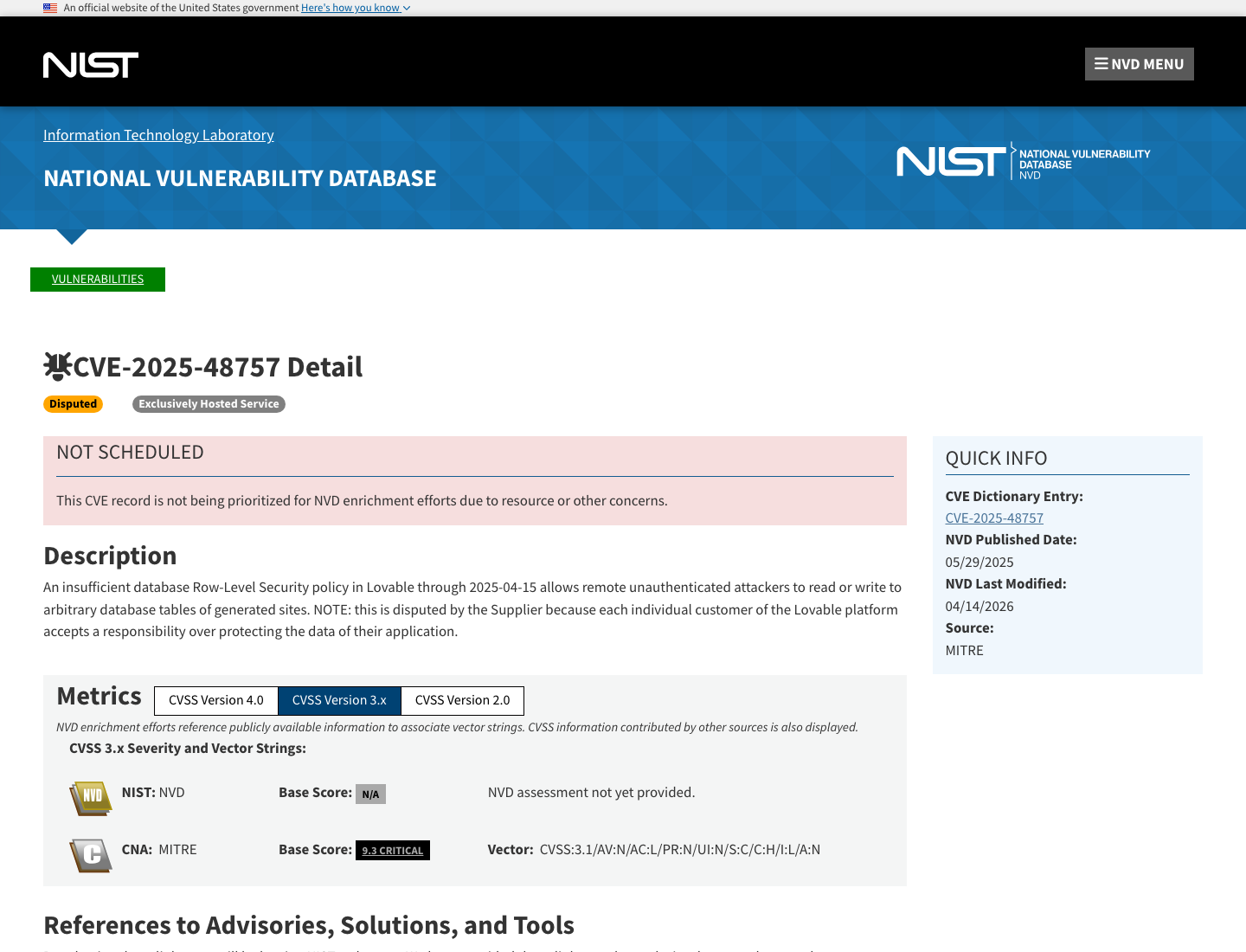
Both sides matter. The exposure was real and measured (303 endpoints across 170 projects). Lovable disputes the CVE on a shared-responsibility basis, arguing each customer owns securing their own app's data. And Lovable later shipped a Security Scan feature with Lovable 2.0 in April 2025 (AIM coverage). The underlying risk is also not unique to Lovable: an experienced developer flagged the broader pattern on HN, "People are using LLMs to generate apps and it's easy for non-technical people to miss this stuff. ... Lovable is not going to tell them to use a proper auth service or fully secure their data." (dmix, Hacker News). The same RLS footgun affects Bolt, v0, and Replit Supabase templates too, so treat it as a category risk.
The practical takeaway you can act on: if you ship a Lovable app with a database, verify Row-Level Security on every table before it goes live.
Who should use Lovable, and who should look elsewhere?
Use Lovable if you are a non-technical founder; look elsewhere if you need production-grade backend logic and security you fully own.
Lovable is a great fit for non-technical founders and PMs validating an MVP, a waitlist, a landing page, or a demo where a live URL by tonight beats a week of setup (sebastiennight and windowshopping above prove it), and for anyone who wants the whole stack handled and will hand the export to a developer to harden.
You will hit its wall if you need production backend logic and security you control, you iterate hard enough to live in credit-loops, you need it to work inside an existing repo (Lovable is greenfield-only), or you stall around the last 30 percent and finish elsewhere. For those profiles, our best Lovable alternative for developers guide covers the codebase-aware pick, Lovable vs Bolt compares the two app builders, and v0 vs Lovable covers the component-versus-full-app split.
How does Superdesign fit alongside Lovable?
We build Superdesign, so judge this paragraph accordingly. The honest map: Lovable and Superdesign live on different layers. Lovable builds the whole app (frontend, backend, database, auth, deploy) from a blank slate. Superdesign designs the UI layer inside the codebase you already have and hands back React and Tailwind you own.
Where Lovable is one linear chat thread you pay per detour, Superdesign forks parallel design directions on an infinite canvas, so you compare before committing. And it ships as a skill inside Claude Code or Cursor (npx skills add superdesigndev/superdesign-skill), so the agent that designs already knows your repo. If you like prompting your way to UI, our free prompt library works with any coding agent.
To be explicit about the limit: Superdesign does not build backends or full apps. If you need the whole stack generated from a prompt, that is Lovable's job, not ours. For the full head-to-head, see Lovable vs Superdesign and the Lovable alternative guide.
The verdict: is Lovable worth it in 2026?
Yes, for the user it was built for. If you are a non-technical founder who wants a working full-stack MVP live today, and you treat the output as a fast first draft to harden later, Lovable genuinely delivers the magic users describe.
Know the asterisks before you put a card in: metered credits that drain in debugging loops (you pay to fix its mistakes), a real complexity wall past prototypes, and a security default (CVE-2025-48757) that has bitten 170+ apps, so verify Row-Level Security on every table before you ship anything with a database. Build your first draft in Lovable with a clear conscience. Just plan for who hardens it.