Google Stitch launched in March 2026 and immediately became the reference point for what AI-powered design looks like. Voice-to-canvas. DESIGN.md files. An MCP server. The Google team even coined the phrase "vibe design" in their announcement. If you haven't tried it yet, it's worth 20 minutes of your time.
But if you're a developer who needs to ship production UI, not mockups, not Figma exports, not screenshots, Stitch has some real gaps. This guide covers the best Google Stitch alternatives for developers who want AI-generated design that goes all the way to deployable code.

Why are developers looking for a Google Stitch alternative?
Google Stitch is a genuinely impressive product for its intended audience: designers and product teams who want to generate visual mockups quickly from natural language or voice prompts. But there's a specific type of user for whom Stitch consistently falls short, the developer who is also the designer.
Here's what Stitch doesn't do well for the developer workflow:
- No production code export. Stitch generates designs, mockups, wireframes, visual specifications. It does not output React, Tailwind, or any other production-ready code you can drop into a project. You still have to implement the design yourself after Stitch generates it.
- No IDE integration. Stitch is a web tool. There's no VS Code extension, no Cursor integration, no Claude Code plugin. If you're building inside your code editor, Stitch requires a context switch to a separate browser tab and back.
- No codebase awareness. Stitch generates designs from scratch. It doesn't know what components you already have, what your Tailwind configuration looks like, or what design tokens your existing UI uses. Every generation starts from zero.
- Still in limited access. As of May 2026, Google Stitch is still rolling out access. If you're on the waitlist and need to ship UI now, you need an alternative anyway.
None of this makes Stitch a bad product. It makes it an incomplete solution for developers. The best Google Stitch alternatives close these gaps, especially the code export and IDE integration gaps.
What should you look for in a Google Stitch alternative?
Before comparing tools, let's be clear about the evaluation criteria. A Google Stitch alternative for designers might prioritize collaboration features, Figma import/export, and visual fidelity. A Google Stitch alternative for developers needs something different:
- Production code output, React, HTML, Tailwind, or framework-specific code that's actually shippable
- IDE integration, works inside VS Code, Cursor, Claude Code, or Windsurf without context-switching
- Codebase awareness, knows your existing components and style system, not generating into a vacuum
- Natural language interface, describe what you want in plain English, not by manipulating a visual canvas
- Fast iteration, generate, tweak, re-prompt in seconds, not minutes
With those criteria, here are the best Google Stitch alternatives in 2026.
1. Superdesign: Best Google Stitch alternative for developers
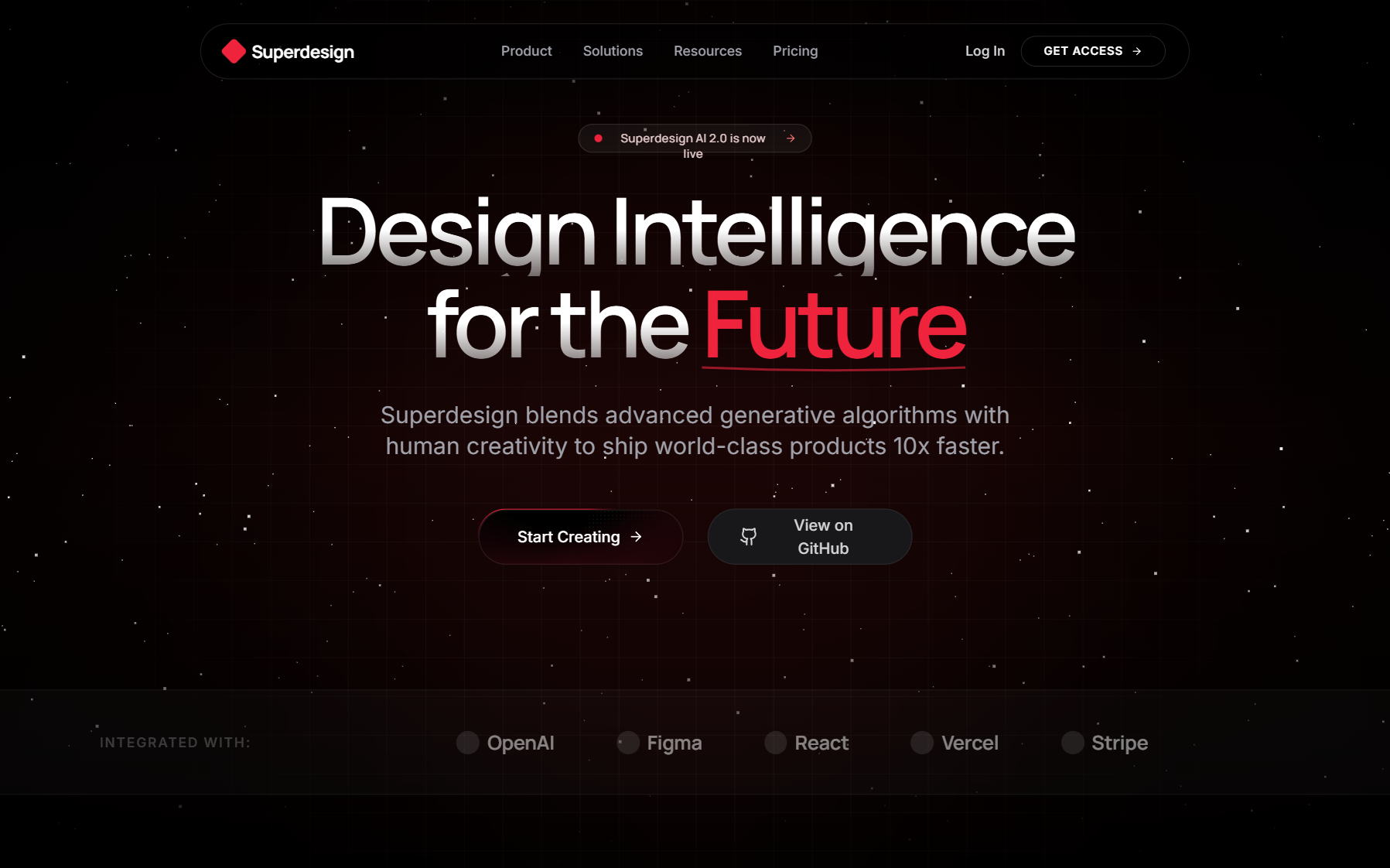
Superdesign is the closest thing to "Google Stitch, but for developers who need to ship code." It's an AI design agent that lives inside your IDE, VS Code, Cursor, Claude Code, and Windsurf are all supported, and generates production-ready UI directly from natural language prompts.
The fundamental difference between Superdesign and Stitch is the output. Stitch gives you a design. Superdesign gives you code. When you describe a UI in Superdesign, you get React components, Tailwind classes, and HTML that can go directly into your project. There's no second step where you hand a mockup to an engineer (or open your editor and re-implement what the AI just showed you).
Where Superdesign beats Stitch for developers
- Lives in your IDE. Install the extension and you're designing inside the same tool you use to write code. No tab-switching, no copy-pasting from a browser window into your editor.
- DESIGN.md for consistency. Like Stitch's DESIGN.md concept, Superdesign uses a DESIGN.md file to define your visual language, typography, colors, spacing, component patterns. Every generation follows these rules automatically, so your UI stays consistent across the whole codebase.
- Codebase-aware generation. Superdesign can see your existing components and style configuration. When you ask for a new screen or component, it generates something that matches your existing UI rather than starting from a default design system.
- Instant variant comparison. Generate three different approaches to a layout side-by-side, pick the best one, and iterate. No manual frame duplication required.
- Available now. No waitlist. Install the extension and start designing in under 5 minutes.
Superdesign Pro is $20/month. For developers who were previously paying a contractor or designer to translate Figma specs into code, or spending hours doing it themselves, the ROI is immediate.
2. V0 by Vercel: Best for quick React component scaffolding
V0 is Vercel's prompt-to-React-component tool. You describe a component, V0 generates shadcn/ui-based React code, and you copy it into your project. It's fast, it's free at the basic tier, and the output quality is genuinely good, especially for standard UI patterns like forms, tables, cards, and navigation.
V0 is a solid Stitch alternative if your primary need is component scaffolding. Its limitations:
- No IDE integration, you work in V0's web interface, then copy-paste
- No codebase awareness, it doesn't know your existing components or style system
- Component-level only, not great for full-page layouts or multi-screen flows
- Opinionated toward shadcn/ui and Tailwind, less useful if you're on a different stack
V0 is the right choice if you want a free, fast tool for React component generation and you're comfortable with the copy-paste workflow. For anything more integrated, Superdesign is the better pick.
3. Bolt.new: Best for full-stack app generation from scratch
Bolt.new is a full-stack app builder: you describe an application, Bolt generates the entire frontend and backend, routing, database schema, authentication, API endpoints. If Stitch is for UI design and V0 is for component generation, Bolt is for spinning up a working app in one prompt.
As a Stitch alternative, Bolt is strongest when you're starting from zero. If you want to prototype a new idea quickly without any existing codebase constraints, Bolt's end-to-end generation is unmatched.
Where Bolt falls short as a Stitch replacement:
- Not an IDE tool, it's a browser-based environment separate from your editor
- Less control over UI specifics, Bolt optimizes for "working app" over "polished UI"
- Adding Bolt-generated UI to an existing project is awkward, it's really for greenfield projects
Use Bolt when you're starting fresh and want a working prototype fast. Use Superdesign when you need to add or improve UI inside an existing codebase.
4. Lovable: Best for non-developers who want a Stitch-like experience
Lovable (formerly GPT Engineer) is an AI-powered full-stack builder targeted at non-technical users. You describe an app, Lovable generates it, and you can edit it through a visual interface without touching code.
As a Google Stitch alternative, Lovable has a similar "describe and generate" flow and is better suited for non-developers who want to build apps without writing code. For developers, it's less useful: the generated code is hard to customize, it runs in a proprietary environment, and integrating with an existing project is not its use case.
Lovable is worth considering if your team includes non-technical stakeholders who need to prototype and ship without engineering support. For developers who want control over their codebase, it's the wrong tool.
5. Magic Patterns: Best for design system generation
Magic Patterns focuses on generating React component libraries and design systems from prompts. You describe the design language you want, the component set, the visual style, the interaction patterns, and Magic Patterns generates a cohesive component library.
It's a niche tool with a specific use case: bootstrapping a design system. If that's what you need, it's excellent. As a Stitch alternative for general UI generation, it's narrower than the other options on this list.
Use Magic Patterns when your primary goal is establishing a new design system from scratch. For ongoing UI generation inside an existing project, the other tools on this list are more versatile.
Google Stitch vs. Superdesign: direct comparison
| Feature | Google Stitch | Superdesign |
|---|---|---|
| Works in IDE (VS Code, Cursor, Claude Code) | No, web only | Yes, native extension |
| Production code output | No, design mockups only | Yes, React, HTML, Tailwind |
| Natural language input | Yes (including voice) | Yes |
| DESIGN.md / style configuration | Yes | Yes |
| Codebase-aware generation | No | Yes |
| Multi-screen / full-page layouts | Yes | Yes |
| Availability | Waitlist (limited access) | Available now |
| Price | Free (limited access) | Free tier + $20/month Pro |
| Best for | Design teams, visual mockups | Developers, production code |
The real question: do you need design mockups or production code?
The choice between Google Stitch and its alternatives often comes down to this question: what's the output you actually need?
If you're a designer who hands off to an engineering team, Stitch's mockup output makes sense. The engineer receives a specification and implements it.
If you're a developer who is also the designer, a solo founder, a vibe coder, a small team without dedicated design resources, the mockup step is pure friction. You don't need a design to hand off. You need the design to be the code. The extra translation step between "design" and "production" is time you're wasting.
This is the core developer case for Superdesign over Stitch. Superdesign skips the mockup entirely. You describe the UI, you get code, you ship it. The design and the implementation are the same artifact.
For vibe coders working in Cursor, Claude Code, or VS Code, this is a meaningful difference in workflow speed. A Stitch-generated mockup requires you to context-switch to a browser, generate the design, then switch back to your editor and implement it. A Superdesign generation happens inside your editor and the output is already in your project.
How do you switch from Google Stitch to Superdesign?
If you've been using Stitch and want to try a code-first alternative, here's how to get started with Superdesign in under 5 minutes:
- Install the Superdesign extension from the VS Code Marketplace or the Cursor extension store
- Open your project in your IDE and activate the Superdesign sidebar
- Create a DESIGN.md file in your project root to define your visual language (or let Superdesign analyze your existing components and generate one for you)
- Describe the UI you want: "A settings page with profile, billing, and notifications sections in a left-sidebar layout"
- Review the generated code, iterate with follow-up prompts, and copy it into your codebase
If you were already using Stitch's DESIGN.md format, the concept transfers directly, Superdesign uses the same configuration approach.